Est.2016
→
∞
Content Repurposing Automation: Turn One Idea into 10 Assets Using AI
automation

Producing content on a consistent basis is one of the biggest challenges for any business. You invest time in writing a blog, recording a video, or sharing an insight, and then move on to the next piece. The effort is high, but the output often stays limited to a single format.
This is where content repurposing automation changes the approach completely. Instead of treating every piece of content as a one-time effort, you turn it into a source that can generate multiple assets across platforms. With the help of AI, one strong idea can be transformed into blog posts, social media content, emails, short-form videos, and more without starting from scratch every time.
The goal is simple. Do the work once and extract maximum value from it.
Why Most Content Strategies Fall Short
Many businesses focus only on creating new content. While consistency is important, constantly producing fresh ideas can quickly become exhausting. Over time, quality drops, messaging becomes repetitive, and the process feels forced.
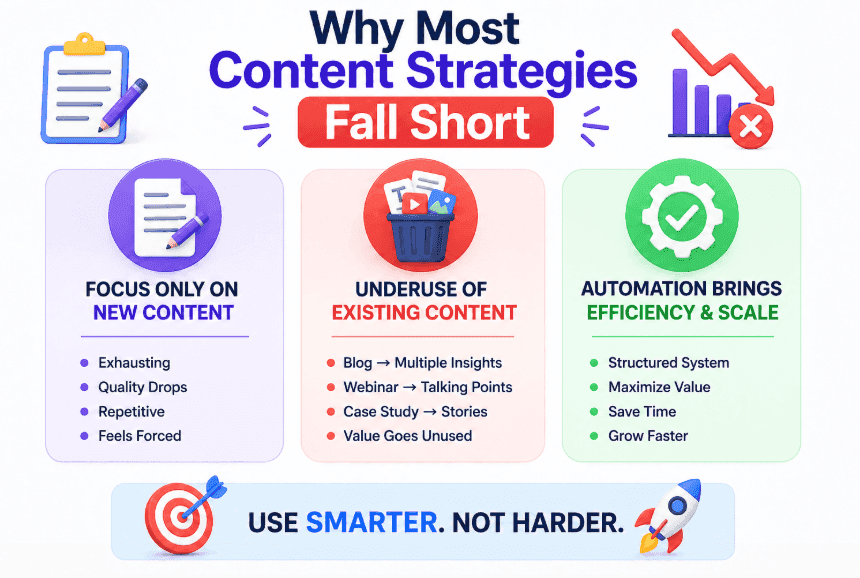
The real problem is not the lack of ideas. It is the underuse of existing content.
A single blog post can contain multiple insights. A webinar can include several talking points. A case study can be broken down into smaller stories. But without a structured system, most of this value goes unused.
This is where automation brings efficiency and scale.
What Content Repurposing Automation Actually Means
Content repurposing automation is about converting one core idea into multiple formats using a structured workflow. Instead of manually rewriting everything, AI helps extract key points, reframe them, and adapt them for different platforms.
For example, a detailed blog post can be transformed into shorter LinkedIn posts, email sequences, or even scripts for short videos. The same idea is presented in different ways, depending on where the audience is engaging.
This approach ensures consistency in messaging while increasing reach across channels.
Turning One Idea Into Multiple Assets
The strength of repurposing lies in how one piece of content can be broken down into several smaller components.
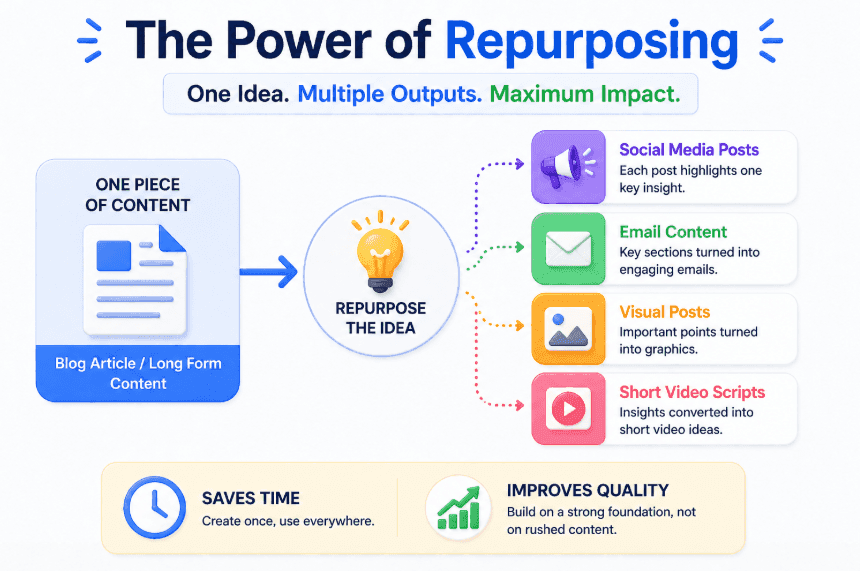
A well-written article can easily generate multiple social media posts, each focusing on a specific insight. Key sections can be converted into email content. Important points can be turned into visual posts or short video scripts.
Instead of thinking about content as individual pieces, you start seeing it as a system where one idea feeds multiple outputs.
This not only saves time but also improves content quality, because you are building on a strong foundation rather than rushing to create something new every time.
Maintaining Consistency Across Platforms
One of the biggest advantages of this approach is consistency. When all your content is derived from a central idea, your messaging remains aligned across platforms.
Your audience may discover you through different channels, but the core message stays the same. This reinforces your positioning and builds stronger recognition over time.
Without repurposing, it is easy for messaging to become scattered. With a structured system, everything connects naturally.
Saving Time Without Losing Quality
Creating high-quality content requires effort. Research, writing, editing, and formatting all take time. When you try to repeat this process for every platform, it quickly becomes overwhelming.
Automation reduces this workload significantly. AI can assist in rewriting, summarizing, and adapting content into different formats. Instead of starting from zero, you refine and expand what already exists.
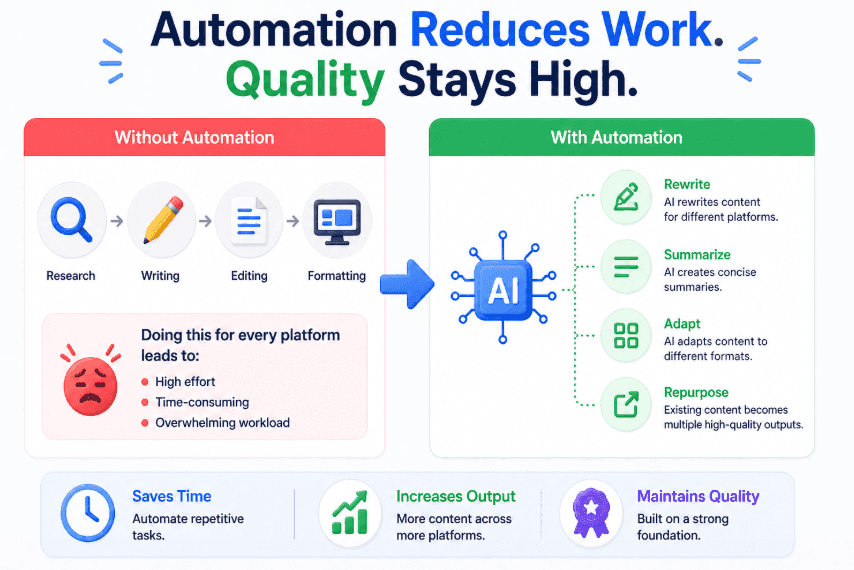
This allows you to maintain quality while increasing output. You are not cutting corners. You are using your resources more effectively.
Building a Scalable Content System
Content repurposing automation is not just about saving time. It is about creating a system that scales with your business.
When you have a repeatable workflow, content production becomes more predictable. You know how one piece will be transformed, where it will be distributed, and how it will support your overall strategy.
This consistency makes it easier to plan campaigns, maintain a steady presence, and reach a wider audience without increasing workload.
Common Mistakes to Avoid
While repurposing is powerful, it needs to be done thoughtfully.
One common mistake is copying the same content across platforms without adapting it. Each platform has its own style and audience expectations. Simply reposting the same message can reduce engagement.
Another issue is over-automation. While AI can handle a large part of the process, human review is still important to maintain quality and relevance.
It is also important to ensure that your original content is strong. Repurposing amplifies what already exists. If the core idea is weak, the output will reflect that.
The Impact on Growth
When content is repurposed effectively, its reach increases significantly. Instead of relying on a single format, you connect with your audience in multiple ways.
This leads to better engagement, stronger brand recall, and more opportunities to convert your audience into customers.
At the same time, your team becomes more efficient. Instead of constantly chasing new ideas, they focus on maximizing the impact of each one.
Final Thoughts
Content creation does not have to be overwhelming. With the right approach, one idea can fuel your entire content strategy.
Content repurposing automation allows you to take a single piece of work and expand it into multiple assets without compromising quality. It brings structure, consistency, and scalability to your content efforts.
In a competitive environment where attention is limited, this approach gives you an advantage. You are not just creating more content. You are creating smarter content that works harder for your business.