Est.2016
→
∞
Cold Outreach Automation: Personalization at Scale Using AI Workflows
automation

Cold outreach has always been a powerful growth channel. But in today’s environment, it has also become one of the most misunderstood. Many businesses still rely on high-volume, generic messaging, hoping that something will stick. The result is predictable. Low response rates, poor engagement, and a damaged sender reputation.
The reality is simple. Cold outreach still works, but only when it is done right.
This is where AI workflows are changing the game. Instead of sending the same message to thousands of people, businesses can now create personalized outreach at scale without increasing manual effort. When structured properly, this approach does not feel like automation. It feels like a series of thoughtful, relevant conversations.
In this article, we will break down how cold outreach automation works and how you can use AI workflows to achieve personalization that actually drives responses.
Why Traditional Cold Outreach Is Failing
Most cold outreach campaigns fail for one reason. They treat every prospect the same.
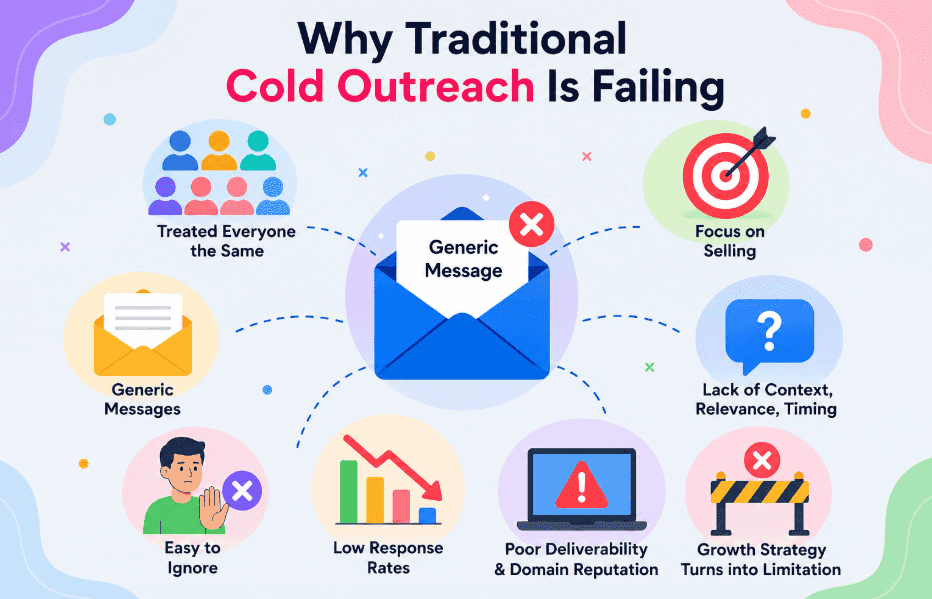
Businesses often build large lists and send identical messages to everyone. These messages usually focus on selling rather than understanding. They lack context, relevance, and timing.
From the recipient’s perspective, it is easy to ignore. The message does not speak to their situation, and it does not offer immediate value.
Over time, this approach not only reduces response rates but also affects domain reputation and deliverability. What starts as a growth strategy turns into a limitation.
The Shift Toward Intelligent Outreach
Modern outreach is not about sending more messages. It is about sending better messages.
AI workflows enable this shift by combining data, automation, and natural language generation. Instead of relying on static templates, you can create dynamic messaging that adapts to each prospect.
At a high level, an AI-driven outreach system focuses on three things:
Understanding who the prospect is
Identifying what matters to them
Crafting a message that reflects that context
When these elements come together, outreach becomes far more effective and sustainable.
Building the Foundation With High-Quality Data
Everything starts with data. Without accurate and relevant information, even the most advanced AI workflows will struggle to deliver results.
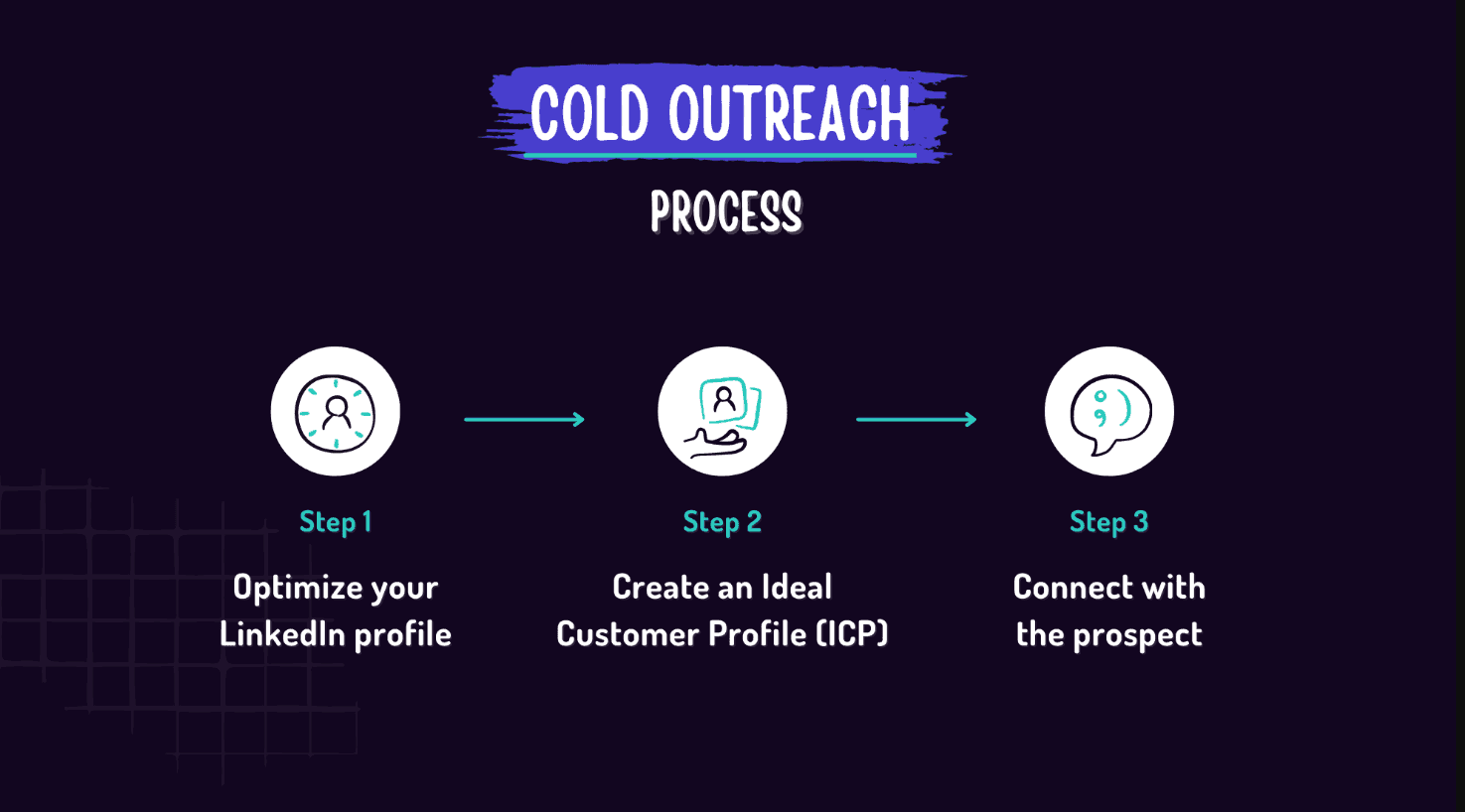
A strong outreach system begins with carefully selected leads. This includes defining your ideal customer profile and targeting individuals who are most likely to benefit from your offering.
Once you have your list, enrichment adds another layer of depth. It provides insights into company size, industry, tools being used, and recent activity. This context is what allows you to move from generic messaging to meaningful communication.
When your data is strong, everything else becomes easier.
Personalization That Goes Beyond First Names
Many businesses believe they are personalizing their outreach when they insert a first name or company name into a template. In reality, this level of personalization is superficial.
True personalization is about relevance.
AI workflows allow you to analyze enriched data and generate messaging that reflects specific situations. Instead of saying “I came across your company,” you can reference something concrete, such as a recent expansion, a tool they are using, or a challenge they are likely facing.
This type of messaging immediately stands out because it shows effort and understanding.
Effective personalization often includes:
Referencing a specific business context
Highlighting a relevant problem
Connecting that problem to your solution
When done correctly, it feels less like outreach and more like a tailored suggestion.
How AI Workflows Enable Scale Without Losing Quality
The biggest advantage of AI is its ability to maintain quality while increasing volume.
Manually writing personalized messages for hundreds of prospects is not practical. AI workflows solve this by generating variations of messages based on predefined logic and data inputs.
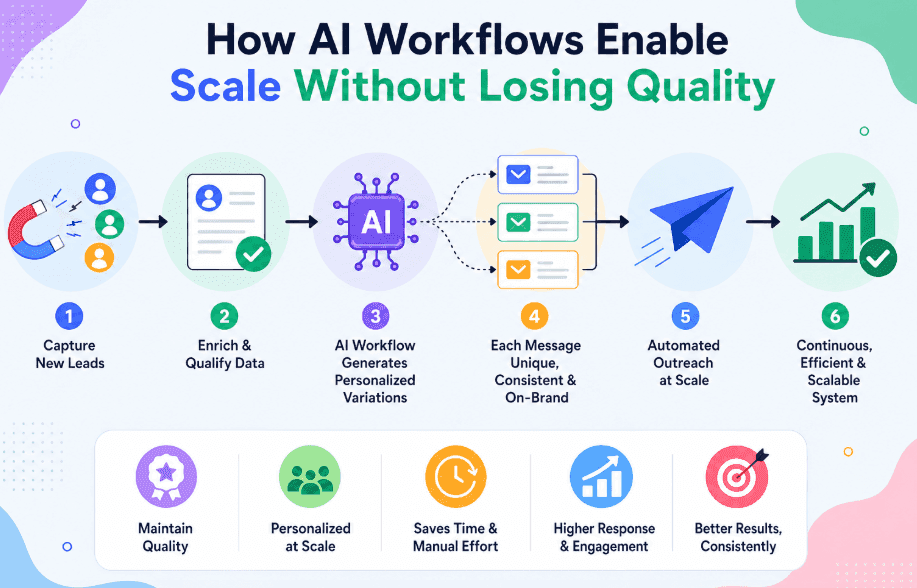
Each message is slightly different, but all follow a consistent structure and tone. This ensures that your outreach remains coherent while still feeling individualized.
More importantly, these workflows can run continuously. New leads can be processed, enriched, and contacted without constant manual involvement.
This creates a system that is both efficient and scalable.
The Role of Follow-Ups in Conversion
Initial outreach is only one part of the process. Follow-ups play an equally important role.
Many responses come after the second or third message, not the first. However, managing follow-ups manually can be inconsistent and time-consuming.
AI automation ensures that follow-ups are timely and relevant. It can adjust messaging based on previous interactions and stop sequences when a response is received.
A well-structured follow-up sequence keeps the conversation alive without being intrusive. It increases visibility and improves the chances of conversion.
Avoiding Common Pitfalls
While AI makes outreach more powerful, it does not eliminate the need for strategy.
One common mistake is over-automation. When businesses rely too heavily on automation without maintaining a human tone, messages can feel robotic.
Another issue is poor targeting. Even the best messaging will fail if it is sent to the wrong audience.
It is also important to continuously test and refine your approach. Small changes in messaging, timing, or targeting can have a significant impact on results.
Keeping the system flexible and adaptive is key.
What This Means for Growth
Cold outreach automation, when done correctly, becomes a reliable growth channel. It allows businesses to consistently reach new prospects, start conversations, and generate opportunities.
More importantly, it removes the unpredictability that often comes with manual outreach. Instead of relying on sporadic efforts, you have a system that works in the background, delivering results over time.
This is particularly valuable for agencies, SaaS companies, and service providers looking to scale without significantly increasing their team size.
Final Thoughts
Cold outreach is not dead. It has simply evolved.
The businesses that succeed today are not the ones sending the most messages. They are the ones sending the most relevant messages.
AI workflows make it possible to combine personalization and scale in a way that was not achievable before. By focusing on quality data, meaningful context, and structured automation, you can create outreach campaigns that feel human and deliver consistent results.
In the end, it is not about automation replacing human interaction. It is about enhancing it.
When used correctly, AI allows you to reach more people while still making each interaction feel personal. And that is what truly drives conversions.